

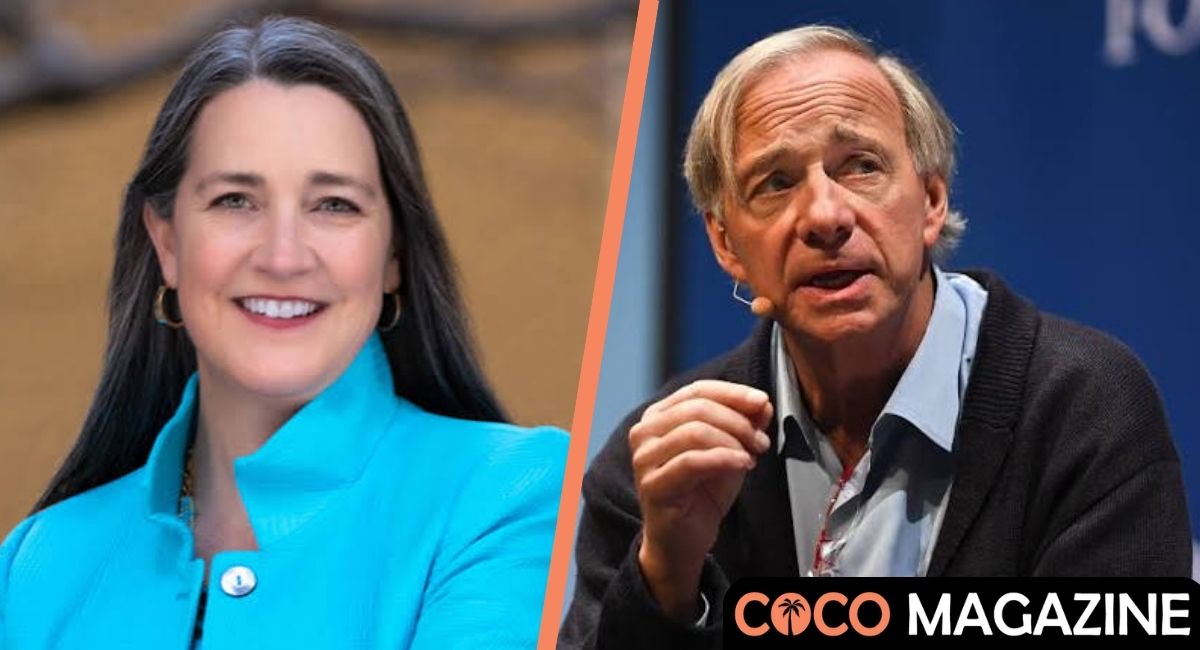
Ray Dalio and Patricia Poppe are two influential business leaders whose careers have attracted attention across finance and the energy industry. Dalio is best known for founding Bridgewater Associates, one of the world’s largest investment management firms. Patricia Poppe, also known as Patti Poppe, leads PG&E Corporation and brings decades of experience in engineering and utility management. Although their professional backgrounds differ, their names became connected through Bridgewater’s reported investment in PG&E shares.
This has sparked questions about their business connection, leadership approaches, and professional influence. Understanding the facts behind Ray Dalio and Patricia Poppe helps separate a documented institutional investment from assumptions about a personal relationship or business partnership.
Who Are Ray Dalio and Patricia Poppe?
Ray Dalio and Patricia Poppe are influential business leaders who built their careers in different industries. Dalio became known for investment management and economic research. Poppe developed her reputation through engineering, manufacturing, and energy operations. Their professional journeys demonstrate how different skills can shape successful careers in large organizations.
Although their names appear together in investment-related searches, they don’t have the same professional responsibilities. Dalio established Bridgewater Associates and developed an influential approach to investing. Poppe leads PG&E Corporation and oversees its corporate direction. Understanding these differences helps explain their connection without creating assumptions about their personal relationship.
Who Is Ray Dalio? His Background and Business Reputation
Ray Dalio is an American billionaire investor, entrepreneur, and author. He founded Bridgewater Associates in 1975 and helped transform it into a major global investment management firm. His work focuses on economic cycles, financial markets, and understanding how different economic conditions affect investments. Over several decades, he became known for combining research, historical patterns, and systematic decision-making.
The Ray Dalio biography begins in Queens, New York, where he grew up in a middle-class family. His father worked as a jazz musician while his mother managed the household. During his childhood, Dalio developed an early interest in financial markets. At around 12 years old, he started investing money earned from small jobs. This early experience helped him understand how stock prices could change and why investors needed patience. His interest eventually developed into a lifelong career in finance. Bridgewater’s founder biography provides additional details about his journey.
Dalio completed his undergraduate studies at C.W. Post College, part of Long Island University, before earning an MBA from Harvard Business School in 1973. His Ray Dalio education gave him a foundation in finance and business management. However, practical experience played an equally important role. He studied economic trends and examined how financial markets reacted to changes in interest rates, inflation, and government policies. These interests later influenced his approach to global macro investing.
Who Is Patricia Poppe? Understanding the CEO Known as Patti Poppe
Patricia Poppe, whose professional name is Patti Poppe, is an American business executive with extensive experience in engineering, manufacturing, and energy management. She serves as the CEO of PG&E Corporation and sits on the boards of both the parent company and its utility subsidiary. Her responsibilities include corporate strategy, financial performance, customer service, and long-term energy planning.
The Patricia Poppe biography reflects a career built through practical experience rather than a single industry. She began in automotive manufacturing before moving into the energy sector. Later, she held senior positions at DTE Energy, CMS Energy, and Consumers Energy. These roles helped her develop knowledge of large industrial operations and public utility management. Her experience eventually led to her appointment at PG&E in January 2021.
Poppe earned bachelor’s and master’s degrees in industrial engineering from Purdue University. She also completed a master’s degree in management at Stanford University Graduate School of Business. Her education combines technical knowledge with executive training. This background helps explain why she has worked across manufacturing, engineering, and energy operations. Purdue also recognizes her achievements as an engineering graduate who became CEO of two major Fortune 500 companies.
Why Are Ray Dalio and Patricia Poppe Being Discussed Together?
The main reason behind the search interest is the reported Bridgewater Associates investment in PG&E Corporation shares. Financial disclosures showed that Bridgewater reported holding PG&E stock for the quarter ending June 30, 2026. Since Poppe leads PG&E Corporation, readers became interested in understanding whether the investment created a direct relationship between the two executives.
However, the distinction matters. Bridgewater operates as an institutional investment manager, while PG&E runs an energy business. A financial filing can show that an investment manager reported shares in a company. It doesn’t automatically show that its founder personally purchased those shares or communicated with that company’s CEO. This difference forms the foundation of the entire Ray Dalio Patricia Poppe connection discussion.
Quick Biography of Ray Dalio and Patricia Poppe
| Biography detail | Ray Dalio | Patricia Poppe |
| Full name | Raymond Thomas Dalio | Patricia K. Poppe |
| Common name | Ray Dalio | Patti Poppe |
| Nationality | American | American |
| Main industry | Investment management | Energy and utilities |
| Known for | Founding Bridgewater Associates | Leading PG&E Corporation |
| Education | C.W. Post College and Harvard Business School | Purdue University and Stanford University |
| Major organization | Bridgewater Associates | PG&E Corporation |
| Professional background | Investor, entrepreneur, author | Engineer and business executive |
| Main expertise | Global macro investing | Utility operations and energy leadership |
What Is the Connection Between Ray Dalio and Patricia Poppe?
The Ray Dalio and Patricia Poppe connection mainly relates to the financial relationship between Bridgewater Associates and PG&E Corporation. Bridgewater’s regulatory filing reported a substantial position in PG&E shares during the second quarter of 2026. Since Poppe serves as PG&E Corporation’s CEO, the investment naturally attracted attention from people following both business leaders.
Still, a corporate investment doesn’t establish a direct partnership. Bridgewater manages investment decisions for institutional and other accounts. PG&E operates in the energy sector under its own management structure. The available filing identifies Bridgewater Associates as the reporting investment manager, but it doesn’t name Dalio as the individual who personally selected or purchased the shares. No direct personal or business partnership between Dalio and Poppe is established by this filing.
The Reported Business Connection Between Bridgewater and PG&E
The connection becomes clearer when examining the companies involved. Bridgewater Associates is an investment management firm that studies financial markets and manages portfolios. PG&E Corporation is a publicly traded energy holding company with operations serving customers across Northern and Central California. Their industries differ, but institutional investors can purchase shares in companies from many sectors.
The June 2026 filing reported that Bridgewater held 5,931,314 shares of PG&E Corporation. The reported market value stood at $99,764,701 on June 30, 2026. These figures explain why the investment attracted attention. However, they describe a reported position at a specific date. They don’t prove that Bridgewater still held the same number of shares on October 31, 2026.
Does Ray Dalio Have a Direct Professional Relationship With Patti Poppe?
This question requires careful attention to available evidence. Ray Dalio built his career in investment management, while Patti Poppe developed her experience in industrial operations and energy leadership. Their professional paths intersect through the reported Bridgewater investment in PG&E rather than a publicly documented executive partnership.
Public company biographies and the relevant SEC filing establish their separate professional positions. However, those records don’t establish that Dalio and Poppe regularly work together, share management responsibilities, or operate a joint business. There may be ordinary interactions between major investors and corporate executives, but that possibility shouldn’t be presented as a confirmed relationship without reliable evidence.
Are Ray Dalio and Patricia Poppe Business Partners?
No publicly available evidence in the cited corporate records establishes that Ray Dalio and Patricia Poppe are business partners. Bridgewater’s reported PG&E position represents an institutional investment disclosure. It doesn’t create a partnership agreement between Dalio and Poppe or establish that they jointly manage a business.
A business partnership normally involves a documented agreement, shared ownership, joint management, or another clearly defined commercial arrangement. An investment manager can own or manage reportable shares in a public company without entering such an arrangement. Therefore, describing them as business partners would go beyond the available evidence.
Why the Difference Between an Institutional and Personal Connection Matters
An institutional investment involves decisions made within an organization that manages money. The firm may employ investment researchers, portfolio managers, risk specialists, and other professionals. These people follow investment policies and make decisions based on the firm’s responsibilities and client accounts. The founder’s name doesn’t automatically identify the person responsible for every individual holding.
This distinction also matters when discussing Ray Dalio business relationships. His historical role as Bridgewater’s founder doesn’t mean he personally directs every investment made by the firm today. In the same way, Poppe’s position at PG&E doesn’t mean she personally negotiates every transaction involving company shareholders. Corporate responsibilities and individual actions are separate matters.
Ray Dalio’s Journey From Investor to Billionaire Business Leader
Few investors have influenced modern investment thinking as much as Ray Dalio. His career shows how curiosity, careful research, and long-term planning can shape a financial institution. The Ray Dalio business career started with small investments and developed into a global operation. Along the way, he built Bridgewater around research, economic understanding, and a distinctive workplace culture.
His success didn’t come from one lucky investment. Dalio spent decades studying markets and examining how economic conditions affect asset prices. He developed methods for understanding uncertainty rather than simply trying to predict every market movement. His Ray Dalio investment philosophy places strong importance on diversification, independent thinking, and learning from mistakes. Those ideas remain central to his public reputation even after his departure from Bridgewater’s executive leadership.
Early Life, Education, and First Steps Into Investing
The Ray Dalio early life story began in Jackson Heights, Queens, New York. He grew up in a modest household and developed an interest in money at an unusually young age. As a teenager, he purchased shares in Northeast Airlines using money earned from caddying. The investment increased in value after an airline merger, giving him an early lesson in market opportunities and financial risk.
Dalio studied finance at C.W. Post College before attending Harvard Business School. He earned his MBA in 1973 and gained experience in financial markets before launching his own investment firm. His academic background helped him understand financial systems, but his curiosity pushed him further. He wanted to understand why markets behaved differently under changing economic conditions. That question became a defining feature of his investment career.
Founding Bridgewater Associates in 1975
In 1975, Dalio founded Bridgewater Associates from his two-bedroom apartment in New York. The company initially focused on economic research and financial advice. Over time, it expanded into a major institutional investment manager. Its growth came from a research-driven approach and a willingness to question traditional investment assumptions.
Bridgewater eventually became known for managing money for large institutional clients. These included pension funds, foundations, and other major investors. The company developed investment strategies designed to respond to different economic conditions. Dalio also shaped its internal culture around open discussion and critical thinking. His goal was to create an environment where employees could challenge ideas instead of accepting decisions without examination.
Understanding Ray Dalio’s All Weather Investment Strategy
The Ray Dalio All Weather strategy is one of his most recognized contributions to investment management. It focuses on building a portfolio that can respond to different economic environments. Rather than depending entirely on one market outcome, the approach considers how assets may perform during economic growth, recession, inflation, and falling inflation.
The strategy uses portfolio diversification, asset allocation, and risk management to balance exposure across different types of investments. It also connects with the concept of risk parity, which focuses on distributing risk rather than simply dividing money equally among assets. For example, stocks may perform well during economic growth but struggle during severe downturns. Bonds or inflation-sensitive assets may behave differently. A diversified portfolio attempts to balance these changing conditions.
The approach doesn’t guarantee profits or protect every portfolio from losses. Instead, it offers a framework for managing uncertainty across economic cycles. Investors should also understand that the All Weather approach involves complex portfolio decisions. Its results depend on asset selection, market conditions, costs, and implementation.
Ray Dalio’s Books, Principles, and Leadership Philosophy
Dalio expanded his influence beyond financial markets through writing. His most recognized book, Principles: Life and Work, explains the ideas that shaped his personal and professional decisions. Published in 2017, it discusses honesty, learning, problem-solving, and building effective teams. The Ray Dalio Principles book became popular among business readers who wanted practical lessons about decision-making.
Another important publication is Principles for Dealing with the Changing World Order. It examines historical economic cycles, debt, reserve currencies, and shifts in global power. Dalio uses historical examples to explain why financial and political systems change over time. His writing encourages readers to study patterns rather than focus only on today’s headlines.
One of his best-known ideas is radical transparency. This approach encourages people to discuss problems openly and challenge assumptions. His concept of idea meritocracy suggests that decisions should reflect the strength of ideas rather than someone’s job title. These Ray Dalio leadership principles helped define Bridgewater’s distinctive workplace culture.
A short principle from his book captures this approach: “Embrace Reality and Deal With It.” It reflects his belief that honest assessments create better decisions.
His Transition Away From Bridgewater’s Leadership and Ownership
Dalio gradually transferred responsibility to the next generation of Bridgewater leaders. He stepped down as CEO in 2017 and later left his chief investment officer role. Bridgewater’s official founder biography records his departure from the chairman position at the end of 2021. These changes marked an important stage in the company’s leadership transition.
The Ray Dalio ownership transition continued after his executive departures. Forbes reported in September 2026 that he had sold his full stake in Bridgewater by 2025. This distinction matters when discussing the firm’s 2026 investment decisions. Dalio remains closely associated with the company’s history and investment philosophy, but his former ownership and executive positions shouldn’t be confused with current operational control.
Ray Dalio’s Influence on Global Finance and Philanthropy
Dalio’s influence reaches beyond the investment industry. His Ray Dalio economic analysis explores debt cycles, inflation, productivity, and changes in global financial power. Investors and policymakers have followed his commentary because he often compares current economic conditions with historical periods. His work encourages people to look at the larger forces behind market movements.
His financial success has also supported philanthropic projects. Through Dalio Philanthropies, he has contributed to education, economic opportunity, and ocean exploration. Forbes reported that his charitable contributions exceeded $1 billion. These activities form another part of his public legacy. His career now includes writing, mentoring, investment-related work, and philanthropy rather than the daily management of Bridgewater.
Ray Dalio Net Worth in 2026
The Ray Dalio net worth figure changes with market conditions and the value of his investments. Forbes estimated his real-time wealth at approximately $18.9 billion on October 30, 2026. This is an estimate rather than a verified statement of his exact cash holdings or personal assets.
His wealth comes mainly from decades of work in hedge funds and investment management. His founding role at Bridgewater played a major part in building that fortune. However, his reported sale of his Bridgewater stake by 2025 means readers should avoid assuming that all his current wealth remains tied to the firm.
Forbes+1
| Ray Dalio financial detail | Information |
| Main source of wealth | Hedge funds and investments |
| Founded Bridgewater | 1975 |
| Stepped down as CEO | 2017 |
| Left chairman position | 2021 |
| Retired as co-CIO | 2022 |
| Reported sale of full Bridgewater stake | By 2025 |
| Forbes estimated net worth | $18.9 billion |
| Estimate date | October 30, 2026 |
Patricia Poppe’s Career From Engineering to Energy Leadership

Patricia Poppe followed a different route to executive leadership. Her professional experience combines industrial engineering, manufacturing, utility operations, and customer service. Instead of building an investment firm, she developed expertise in managing large organizations that provide essential services. Her career demonstrates how technical education can support senior business leadership.
The Patricia Poppe career story also highlights the importance of adapting to new industries. She moved from automotive manufacturing into the energy business and eventually became a senior executive at two major utility companies. Her work at PG&E involves challenges that affect millions of customers. These include electricity reliability, energy costs, infrastructure safety, and California’s wildfire risks.
Early Life, Education, and Industrial Engineering Background
Poppe’s educational background played a central role in her professional development. She earned a bachelor’s degree in industrial engineering from Purdue University in 1989. She later completed a master’s degree in the same field in 1991. These qualifications gave her technical knowledge of manufacturing systems, production processes, and operational efficiency.
She also earned a master’s degree in management from Stanford University Graduate School of Business. This additional training strengthened her understanding of business strategy and executive decision-making. Her combination of engineering and management education prepared her for roles involving complex operations. It also helped her move between manufacturing and the energy industry without leaving her technical foundation behind.
Starting Her Professional Career at General Motors
Poppe began her professional journey at General Motors, where she spent approximately 15 years. She worked in several plant management positions and gained experience in automotive manufacturing. Her responsibilities involved production systems, workforce coordination, and operational performance. These roles exposed her to the daily demands of running large industrial facilities.
Manufacturing operations require close attention to safety, quality, cost, and productivity. A small process failure can affect thousands of products and disrupt entire production lines. Poppe’s experience in this environment helped her develop practical leadership skills. It also provided a strong foundation for her later work in the energy sector.
Moving Into Energy Leadership at DTE Energy
After her years at General Motors, Poppe moved into the energy business through DTE Energy. She joined the company in 2005 and worked in leadership positions involving plant operations and performance improvement. Her responsibilities included power generation and regulated energy operations.
This transition was important because utility companies face challenges beyond ordinary manufacturing. They must maintain reliable services, follow strict regulations, and respond to customer needs. Power plants also require careful maintenance and safety procedures. Poppe’s experience helped her understand how industrial systems and energy infrastructure depend on disciplined operations.
Her Leadership at CMS Energy and Consumers Energy
Poppe later joined CMS Energy and its subsidiary, Consumers Energy. She held several senior positions before becoming president and CEO in 2016. Her work included customer operations, distribution systems, engineering, transmission, rates, and regulation. These responsibilities gave her a broad understanding of how utilities serve residential and business customers.
At Consumers Energy, she emphasized customer experience and operational improvement. The company also focused on safety and energy efficiency during her leadership. According to PG&E’s appointment announcement, safety incidents at Consumers Energy had decreased substantially over the years preceding her departure. Her experience in Michigan made her a strong candidate for another major utility leadership role.
Becoming the CEO of PG&E Corporation in 2021
In November 2020, PG&E announced Poppe’s appointment as CEO, effective January 4, 2021. She joined the company after leading CMS Energy and Consumers Energy. Her appointment came during an important period for the California utility. PG&E faced serious questions about safety, infrastructure reliability, customer trust, and wildfire prevention.
Her responsibilities included guiding the parent company through financial and operational challenges. She also had to strengthen relationships with regulators, customers, employees, and communities. Her background in engineering and energy operations provided experience relevant to these demands. PG&E’s official announcement highlighted her understanding of utility operations and commitment to reliable and affordable energy.
An important distinction applies in 2026. Patti Poppe remains CEO of PG&E Corporation, the parent company. Following organizational changes effective January 1, 2026, Sumeet Singh became CEO of the utility subsidiary, Pacific Gas and Electric Company. Therefore, describing Poppe as CEO of the entire operating utility without explaining the corporate structure can create confusion.
Patricia Poppe’s Leadership Priorities at PG&E
The Patricia Poppe PG&E leadership agenda focuses on safety, reliability, affordability, and clean energy. The company serves approximately 16 million people across Northern and Central California. This responsibility makes infrastructure maintenance a major priority. Power lines, substations, gas systems, and other facilities require ongoing investment and careful management.
Wildfire prevention remains one of the most important challenges. California’s dry conditions and extreme weather can increase the risk of fires involving electrical equipment. PG&E has invested in underground power lines, inspections, vegetation management, and other safety measures. Poppe’s leadership also emphasizes operational efficiency and customer trust. These goals are closely connected because customers expect reliable service at a reasonable cost.
What Does PG&E Corporation Do?
PG&E Corporation is the parent company of Pacific Gas and Electric Company. Its utility subsidiary delivers electricity and natural gas to customers across much of Northern and Central California. The distinction between the two organizations matters because corporate leadership and daily utility operations involve separate responsibilities.
The company operates in a demanding regulatory environment. It must maintain infrastructure, meet safety requirements, manage energy demand, and work with California regulators. Its services support homes, businesses, public institutions, and industrial customers. Because electricity and natural gas are essential services, operational decisions can affect entire communities. This makes PG&E’s leadership responsibilities different from those of an investment firm such as Bridgewater.
The Bridgewater–PG&E Investment Connection Explained
The Bridgewater–PG&E investment connection provides the clearest documented reason behind searches for Ray Dalio and Patricia Poppe together. Bridgewater Associates reported a position in PG&E Corporation stock through a regulatory filing. Since PG&E operates under Poppe’s corporate leadership, the reported holding created a link between their names in financial discussions.
However, the filing needs careful interpretation. It identifies Bridgewater Associates, LP as the institutional reporting manager. It doesn’t identify Ray Dalio as the person who personally selected the shares. It also doesn’t explain the investment’s purpose or establish a direct relationship with PG&E’s executive team. Understanding the filing helps separate financial facts from assumptions.
Why Bridgewater Associates’ PG&E Investment Attracted Attention
Institutional investors often hold shares in companies across different industries. Their portfolios may include technology businesses, banks, healthcare companies, energy providers, and manufacturers. Bridgewater’s reported PG&E position attracted attention because the investment connected a major financial firm with a prominent California utility.
The energy sector also faces important long-term questions. Electricity demand, infrastructure spending, wildfire prevention, and regulatory changes can influence utility companies. Investors study these factors when assessing potential opportunities and risks. However, a reported shareholding doesn’t reveal whether the investment reflects confidence in management, expectations about future earnings, or another portfolio decision. The filing alone doesn’t explain the reason behind Bridgewater’s position.
What Does the SEC Form 13F Filing Reveal?
A SEC Form 13F filing is a quarterly disclosure submitted by certain institutional investment managers. The Securities and Exchange Commission (SEC) requires qualifying managers to report specified securities over which they exercise investment discretion. The filing gives investors a useful view of reportable institutional holdings.
Under the reporting rules, qualifying managers generally file within 45 days after the end of each calendar quarter. A June 30 filing therefore provides a snapshot of reportable positions on that date. It doesn’t necessarily show what a manager owns when readers access the filing weeks later. Form 13F also doesn’t provide a complete picture of every investment, transaction, or short position.
Bridgewater’s Reported PG&E Stock Holdings in 2026
The relevant PG&E investment filing was submitted on August 14, 2026. It covered Bridgewater Associates’ reportable holdings as of June 30, 2026. The SEC information table lists PG&E Corporation common stock with a reported value of $99,764,701 and 5,931,314 shares.
These numbers provide the strongest factual detail behind the Bridgewater PG&E stock holdings discussion. They show that Bridgewater reported a substantial PG&E position for that reporting period. They don’t confirm that the firm retained the same shares after June 30. Nor do they show that Dalio personally owned the position.
| SEC filing detail | Reported information |
| Reporting institution | Bridgewater Associates, LP |
| Company | PG&E Corporation |
| Stock type | Common stock |
| Reporting period | June 30, 2026 |
| Reported shares | 5,931,314 |
| Reported market value | $99,764,701 |
| Filing date | August 14, 2026 |
| Regulatory document | Form 13F-HR |
The figures above come directly from the SEC’s Bridgewater filing. The SEC also states that it hasn’t necessarily reviewed the filing or determined whether its information is accurate and complete. Readers should therefore treat it as a regulatory disclosure rather than an independent SEC endorsement.
Did Ray Dalio Personally Purchase PG&E Shares?
The available filing doesn’t establish a personal Ray Dalio investment in PG&E. It identifies Bridgewater Associates, LP as the reporting institution. This distinction is important because Dalio’s former leadership role doesn’t make every institutional investment his personal transaction.
Large investment firms employ professionals who research securities and manage portfolios. Their decisions may involve different teams, investment strategies, and client accounts. The SEC disclosure identifies the institution responsible for reporting the position. It doesn’t provide evidence that Dalio personally purchased 5,931,314 PG&E shares or directed that specific trade.
Does the Investment Establish a Partnership With Patricia Poppe?
No. The investment doesn’t establish a partnership between Dalio and Poppe. It shows that Bridgewater reported PG&E stock in its institutional portfolio for a specific reporting period. It doesn’t demonstrate a joint venture, shared ownership arrangement, personal agreement, or direct business collaboration.
A corporate investment relationship can exist without a personal relationship between executives. Public companies often have thousands of shareholders, including investment funds and asset managers. Their CEOs don’t automatically become business partners with every institution holding company stock. In this case, the available documentation supports an institutional investment connection rather than a confirmed personal partnership.
Why Investors Pay Attention to PG&E and the Energy Industry
Utilities attract institutional interest because they provide essential services. Their businesses depend on long-term infrastructure, regulated revenue structures, and continuing investment. Electricity demand can also change as homes adopt electric vehicles, industries expand, and data centers require more power.
At the same time, utility companies face serious financial and operational risks. Wildfires, storms, equipment failures, regulatory decisions, and borrowing costs can affect their performance. PG&E must balance these challenges while maintaining service for millions of customers. Investors studying the company may examine its financial position, safety spending, and future energy demand. These factors help explain why an investment manager might include a utility company in its portfolio.
Ray Dalio and Patricia Poppe: Comparing Their Leadership Styles

Although Ray Dalio and Patricia Poppe work in different industries, their careers offer useful lessons about leadership. Dalio built an investment organization around research, economic analysis, and open debate. Poppe developed her leadership approach through manufacturing and energy operations. Both have managed complex organizations where decisions can carry significant financial consequences.
Their responsibilities also require different kinds of expertise. Dalio’s work focuses on financial markets, portfolio decisions, and economic cycles. Poppe’s work involves energy infrastructure, customer service, operational safety, and corporate performance. This business leadership comparison shows how leaders adapt their methods to the industries they serve.
Ray Dalio’s Approach to Investment Decisions and Risk Management
Dalio’s leadership approach centers on research, independent thinking, and systematic decision-making. He encourages people to question assumptions and examine evidence before reaching conclusions. His investment methods also rely on understanding how economic conditions affect different assets. Instead of depending on one prediction, he studies several possible outcomes and considers their risks.
His emphasis on risk management reflects the uncertainty of financial markets. Interest rates, inflation, debt levels, and economic growth can influence investment performance. Dalio’s approach encourages diversification and careful portfolio construction. His concept of radical transparency also supports open discussion within organizations. Employees should identify mistakes and challenge weak ideas rather than hide uncomfortable information.
Patricia Poppe’s Approach to Operational and Energy Management
Poppe’s leadership style focuses on practical improvements that affect employees and customers. Her engineering background helps her understand complicated industrial systems. Meanwhile, her experience at General Motors, DTE Energy, and Consumers Energy provided insight into workforce management and large-scale operations.
The Patricia Poppe leadership style emphasizes safety, customer experience, efficiency, and organizational accountability. At PG&E, these priorities have direct consequences for communities. Reliable electricity requires well-maintained equipment and strong operational planning. Wildfire prevention also requires investment, inspections, and coordination across different teams. Her leadership therefore involves balancing immediate service needs with long-term infrastructure improvements.
How Their Leadership Philosophies Differ
Dalio and Poppe share an interest in disciplined decision-making, but their daily responsibilities differ. Dalio examines markets and investment opportunities. Poppe manages a company responsible for delivering essential energy services. One works mainly with financial risks while the other deals with physical infrastructure, customer needs, and public safety.
Their approaches can be compared through several business principles. Dalio emphasizes economic patterns and portfolio diversification. Poppe focuses on operational performance and reliable energy delivery. Both recognize the importance of learning from mistakes. However, the results they seek are different. An investment manager aims to manage capital effectively, while a utility executive must maintain essential services and meet regulatory responsibilities.
| Leadership factor | Ray Dalio | Patricia Poppe |
| Main industry | Investment management | Energy and utilities |
| Main focus | Financial performance | Safety and service reliability |
| Decision-making | Research and economic analysis | Engineering and operational data |
| Risk priorities | Market and portfolio risks | Infrastructure and operational risks |
| Leadership concepts | Radical transparency and idea meritocracy | Accountability and customer experience |
| Long-term objective | Sustainable investment performance | Reliable and affordable energy |
Important Leadership Lessons From Their Careers
Their careers highlight the value of preparation and adaptability. Dalio built his business by studying economic patterns and refining investment methods. Poppe developed her expertise by moving through technical and management positions. Both journeys show that strong leadership often grows through experience rather than appearing overnight.
Another important lesson involves the willingness to question existing systems. Dalio encouraged employees to challenge ideas openly. Poppe has emphasized operational improvements and organizational change. Their experiences suggest that successful organizations need clear goals, honest communication, and consistent learning. These principles apply across many industries, even when the daily work looks completely different.
Why Are People Searching for Ray Dalio and Patricia Poppe Together?
Search interest in Ray Dalio and Patricia Poppe together mainly comes from the connection between Bridgewater’s investment disclosures and PG&E Corporation. When financial databases report that a major investment manager holds shares in a public company, readers often search for its executives. In this case, Poppe’s position at PG&E makes her name relevant to discussions about Bridgewater’s reported investment.
Another reason involves the difference between personal names and corporate entities. People often associate a famous founder with every decision made by the organization he created. This can lead to confusion about ownership, management, and investment activity. Understanding the actual company structure helps readers find accurate answers instead of relying on assumptions.
The Role of Bridgewater’s Investment Reports
Investment reports make institutional holdings easier to track. Investors, journalists, analysts, and ordinary readers can examine public filings to see which reportable securities a firm holds. When Bridgewater reported PG&E shares in June 2026, the disclosure created a searchable connection between the two companies.
These reports also help readers understand how large investment managers distribute capital. However, they provide only a limited view of investment activity. They don’t explain every decision or reveal the full reasoning behind a portfolio position. Readers should examine the reporting date and the institution named in the document before drawing conclusions.
Growing Interest in Corporate Investment Connections
People naturally pay attention when prominent business figures appear in the same financial story. Dalio has a well-known reputation in investment management, while Poppe leads a major American utility company. Their industries attract different audiences, yet financial disclosures can bring those audiences together.
This interest also reflects a broader curiosity about how institutional investors influence public companies. Large shareholders can attract attention because their holdings may affect voting power and market discussions. However, an investment position doesn’t automatically give an investor control over company operations. The exact influence depends on ownership size, voting rights, governance rules, and other factors.
How Search Engines Connect Business Leaders and Companies
Search engines organize information around people, organizations, locations, and relationships. When Bridgewater Associates appears in a filing involving PG&E Corporation, search systems can connect the companies. They may also associate Dalio with Bridgewater and Poppe with PG&E because of their professional roles.
This explains why a search for Ray Dalio Patricia Poppe connection can return pages discussing both biographies. It doesn’t mean search engines have confirmed a personal relationship. Search results often reflect shared business context rather than direct interaction. Readers should always examine the underlying evidence before accepting claims about two public figures.
Separating Verified Facts From Online Speculation
Online articles sometimes turn a simple investment disclosure into a dramatic business relationship story. That approach may attract clicks, but it can mislead readers. A responsible article should identify the source, reporting date, and exact information contained in the document.
For example, the SEC filing confirms that Bridgewater reported PG&E shares for June 30, 2026. PG&E’s official biography confirms Poppe’s position as CEO of the parent company. Neither source establishes that she and Dalio entered a partnership. Keeping these facts separate makes the topic easier to understand and protects the article’s credibility.
Ray Dalio and Patricia Poppe’s Professional Lives in 2026
By 2026, both figures have established careers and recognizable positions in their respective industries. Dalio has moved away from the executive responsibilities he once held at Bridgewater. He now focuses more on investing, writing, mentoring, and sharing his economic views. Poppe continues to lead PG&E Corporation as the company addresses major infrastructure and financial challenges.
Their current positions provide important context for understanding the Ray Dalio and Patricia Poppe relationship search. Dalio’s connection to Bridgewater remains part of his professional legacy. Poppe’s work at PG&E centers on the company’s future and its responsibility to California customers. Their careers continue along separate paths, even though the reported investment connects their organizations.
What Is Ray Dalio Doing in 2026?
Ray Dalio remains active in investment-related discussions and economic commentary. He shares views on debt, inflation, global financial systems, and long-term economic changes. His books also continue to influence readers interested in business management and investment thinking. Rather than focusing on daily Bridgewater operations, he has shifted toward mentoring and sharing lessons from his career.
His reported wealth remains another area of public interest. Forbes estimated his net worth at approximately $18.9 billion on October 30, 2026. This figure reflects an external wealth estimate and can change as markets and asset values move. His philanthropic interests also remain part of his public activities, particularly in education and ocean exploration.
Patricia Poppe’s Current Role at PG&E in 2026
Patricia Poppe CEO responsibilities focus on PG&E Corporation’s overall corporate direction. She continues to oversee the parent company’s executive strategy and sits on its board. Her work includes financial performance, infrastructure planning, customer trust, and the company’s long-term energy goals.
An important organizational change took effect in January 2026. PG&E appointed Sumeet Singh as CEO of Pacific Gas and Electric Company, its operating utility subsidiary. Poppe retained her position as CEO of PG&E Corporation. This distinction matters because the parent company and its utility subsidiary have separate corporate responsibilities.
PG&E’s Strategic Challenges and Future Plans
PG&E announced a strategic review on September 2, 2026. The company said it wanted to strengthen its financial position and attract the investment needed to serve California customers. It also announced plans to reduce its 2027 capital spending by approximately $2 billion. The decision aimed to manage borrowing needs while maintaining critical safety investments.
The company also reported progress on infrastructure and wildfire prevention. In its October 22, 2026 third-quarter results, PG&E discussed a proposed 5,000-mile undergrounding plan. The plan aims to reduce wildfire risk and outages on lines moved underground. However, such projects involve significant costs and long timelines. PG&E must balance safety improvements with the need to keep customer bills affordable.
These challenges show why Poppe’s role involves more than ordinary corporate management. California utilities operate under strict regulations and face environmental risks. They must invest in infrastructure while responding to customer concerns about electricity costs. The company’s financial decisions also influence its ability to maintain and upgrade essential services.
Their Continued Influence on Business and Industry
Dalio’s influence comes mainly from his investment philosophy and economic research. His ideas about diversification, debt cycles, and decision-making continue to attract business readers. His books offer a framework for understanding markets and organizational behavior. Even without his former executive responsibilities, his work remains part of investment discussions.
Poppe’s influence comes from her leadership in the energy industry. She works within a business that affects millions of people and supports California’s economic activity. Her decisions involve infrastructure, safety, financial planning, and customer service. Their professional contributions differ, but both careers show how leadership can shape major organizations and influence wider industries.
Final Thoughts on Ray Dalio and Patricia Poppe
The story of Ray Dalio and Patricia Poppe brings together two different careers and industries. Dalio built Bridgewater Associates through decades of investment research and financial decision-making. Poppe developed her career through engineering, manufacturing, and energy leadership. Their professional journeys offer valuable examples of how different skills can shape major organizations.
The strongest documented connection between them involves Bridgewater’s reported investment in PG&E Corporation. The June 2026 SEC filing provides evidence of an institutional stock position, not a personal partnership. There is no established evidence in the cited records showing that Dalio and Poppe jointly operate a business. Their careers remain separate, but the investment disclosure explains why people continue searching for their names together.
Ultimately, their story highlights the importance of understanding corporate structures, financial disclosures, and executive responsibilities. It also shows how investment management and energy operations influence different parts of the American economy. Looking beyond headlines helps readers understand the actual facts.
FAQ’s About Ray Dalio and Patricia Poppe
Who are Ray Dalio and Patricia Poppe?
Ray Dalio is an American billionaire investor and founder of Bridgewater Associates. Patricia “Patti” Poppe is an American business executive and CEO of PG&E Corporation.
Who is Patti Poppe’s husband?
Patti Poppe is reportedly married to Eric Poppe. However, detailed information about their marriage remains limited.
How credible is Ray Dalio?
Ray Dalio is a widely recognized investor with more than 50 years of experience. His Bridgewater track record and published investment principles establish his influence, although his opinions and market predictions should still be evaluated critically.
Where does Ray Dalio reside?
Forbes lists Greenwich, Connecticut, as Ray Dalio’s residence.
How old is Patti Poppe?
Patti Poppe’s exact birth date is not clearly confirmed by reliable official biographies. Some online sources estimate she was born around 1969–1970, which would make her approximately 56–57 in 2026.
People Read Also: Juliette Vann: Biography, Career, Marriage to Darius McCrary, and Life Today

Welcome to Coco Magazine! I’m a digital marketer and content writer with over 9 years of experience, helping brands grow through strategic content and ethical outreach. Guest contributors and collaborators are always welcome here.
1 thought on “Ray Dalio and Patricia Poppe: Their Connection, Careers, and Leadership Journeys”