

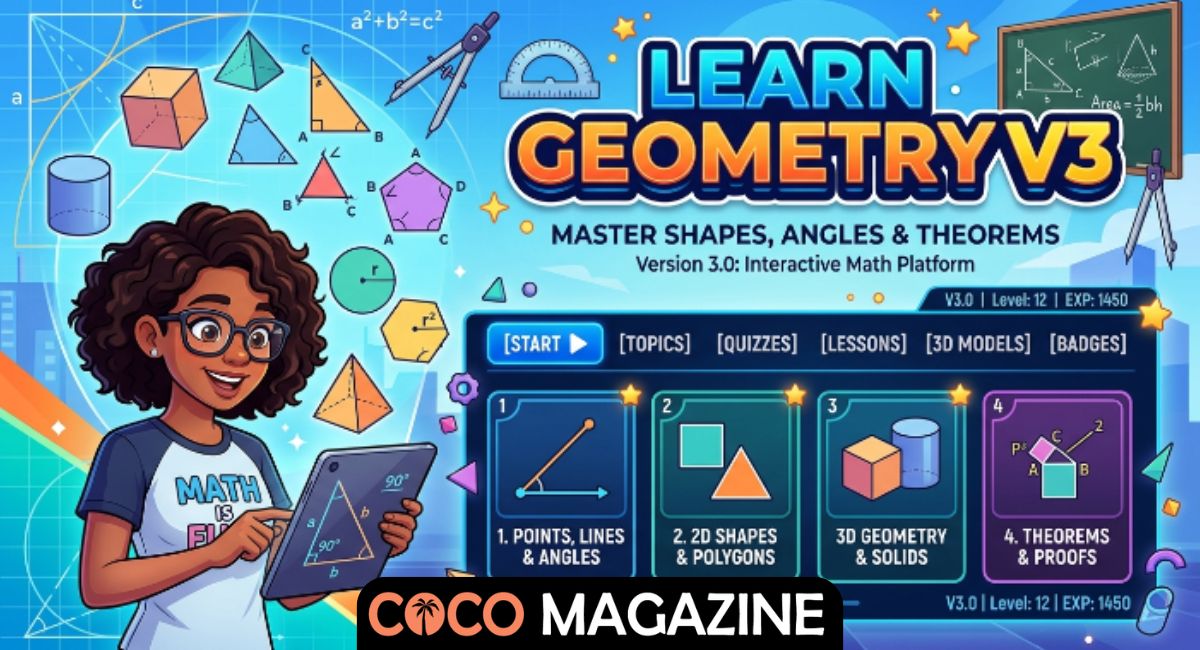
Geometry Learn V3 is becoming one of the most talked-about tools for modern math education in 2026. Instead of relying only on textbooks and memorization, it introduces a more engaging way to explore shapes, angles, and spatial relationships through Interactive geometry learning. Many students find geometry difficult because concepts can feel abstract, but this platform helps make them easier to understand through Visual geometry learning and hands-on activities.
Whether you are a beginner, teacher, or independent learner, Geometry Learn V3 offers a practical approach to studying geometry. As a modern Geometry learning platform, it combines technology, exploration, and Real-time feedback to create a more effective and enjoyable learning experience for users.
Quick Overview of Geometry Learn V3
Many people searching for Geometry Learn V3 want a quick answer before diving deeper. At its core, it is a modern educational environment that focuses on visual interaction rather than simple memorization. Instead of reading long explanations about shapes and formulas, learners can explore concepts directly through movement, observation, and experimentation. This approach supports Visual geometry learning and helps users develop stronger mathematical intuition.
As educational technology continues to evolve across the United States, students increasingly prefer platforms that encourage participation. A good Geometry learning platform allows learners to engage with concepts actively rather than passively. That is one reason many people describe Geometry Learn V3 as a modern solution for understanding geometry concepts in a more practical and enjoyable way.
Quick Facts Table About Geometry Learn V3
| Feature | Details |
| Name | Geometry Learn V3 |
| Category | Geometry learning platform |
| Learning Style | Interactive and visual |
| Accessibility | Browser-based access |
| Target Users | Students, teachers, and independent learners |
| Focus Areas | Shapes, angles, spatial reasoning, and geometry concepts |
| Learning Method | Learning by doing |
| Device Support | Desktop, laptop, Chromebook, and mobile browser |
| Key Benefit | Improved understanding through visual interaction |
| Popularity | Growing in 2026 |
Who Uses Geometry Learn V3?
Students often use Geometry Learn V3 for students because it helps simplify difficult concepts through visual demonstrations. Many learners struggle when geometry becomes abstract. Seeing shapes move and change can make a dramatic difference in understanding. This method supports stronger Critical thinking, Problem-solving skills, and long-term comprehension.
Educators and parents also find value in modern learning systems. Geometry Learn V3 for teachers provides opportunities to introduce geometry concepts in a more engaging way. Meanwhile, Geometry Learn V3 for self learners offers flexibility for adults who want to refresh forgotten math skills without returning to a traditional classroom setting.
Key Highlights at a Glance
One reason this platform continues to gain attention is its focus on engagement. Instead of relying only on memorization, learners interact directly with concepts. This creates a more memorable Learning experience and supports better Learning retention. Research consistently shows that students understand mathematical concepts faster when they can visualize relationships rather than simply read about them.
Another advantage is accessibility. Since many modern tools operate as a Browser-based learning platform, learners can access content from nearly any device with an internet connection. This convenience supports Self-paced learning and allows users to practice whenever they have time.
What Is Geometry Learn V3?
When people ask What is Geometry Learn V3, they are usually looking for a simple explanation. The easiest way to understand it is to think of it as a modern educational environment designed to make geometry easier, more visual, and more interactive. Rather than focusing entirely on formulas and memorization, it encourages users to explore relationships between shapes, measurements, and spatial structures through direct interaction.
The platform aligns closely with current trends in Educational technology geometry. Today’s learners expect dynamic content rather than static pages. By combining visual exploration with immediate responses, Geometry Learn V3 supports a more natural learning process that helps students understand concepts rather than simply remember them for an exam.
Understanding the Meaning Behind Geometry Learn V3
The term itself suggests an updated version of a learning system. The “V3” often implies refinement, improvement, and modernization. While earlier educational tools relied heavily on text-based explanations, newer systems emphasize Interactive mathematics and visual exploration. This reflects broader changes happening throughout Digital education.
For many learners, geometry becomes easier when they can see relationships in action. Watching shapes transform provides insight that a textbook diagram often cannot. This visual approach supports Concept-based learning, helping learners understand the “why” behind formulas instead of simply memorizing procedures.
Is Geometry Learn V3 a Learning Platform, Tool, or Web Hub?
One reason people remain curious about Geometry Learn V3 review 2026 discussions is that different sources describe it differently. Some view it as an educational resource, while others describe it as a broader online environment connected with student-friendly tools and activities. Regardless of how it is categorized, the central appeal remains the same: accessibility and engagement.
From a practical standpoint, users often approach it as an Online geometry learning tool that helps them explore mathematical concepts visually. Whether used as a complete learning resource or as a supplementary Geometry practice tool, its primary value comes from making geometry feel more approachable.
Why the Name Creates Confusion for Some Users
The name naturally creates expectations. When people hear “Geometry Learn,” they immediately think of formal lessons, structured courses, and academic instruction. However, some users discover that the experience feels more flexible and exploratory than a traditional course.
This confusion is not necessarily a disadvantage. In fact, many learners appreciate environments that encourage discovery. A rigid curriculum works for some students. Others learn better when they can experiment, make mistakes, and learn through exploration. That flexibility is one reason the platform continues to attract attention from learners with different educational needs.
Why Geometry Learn V3 Is Gaining Attention in 2026
Educational trends in 2026 continue moving toward personalization and interaction. Students want tools that adapt to their learning styles rather than forcing everyone into the same approach. This shift explains why Geometry Learn V3 has become increasingly visible among discussions about the Best geometry learning platform options available today.
Modern learners also expect technology to simplify difficult concepts. Traditional geometry often feels intimidating because many ideas seem abstract. Visual systems bridge that gap by transforming complex mathematical relationships into experiences that learners can observe and manipulate directly.
The Rise of Digital Geometry Learning
Over the last decade, classrooms across the United States have embraced technology-driven instruction. As a result, Digital geometry learning has become a major educational trend. Instead of relying solely on paper diagrams, students can now interact with mathematical models in real time.
This shift improves understanding because geometry is inherently visual. Concepts involving space, movement, and measurement become easier when learners can observe them dynamically. Many experts consider this transition one of the most significant developments in modern mathematics education.
Why Students Prefer Interactive Geometry Learning Tools
Students often struggle with abstract concepts because they cannot easily visualize them. An Interactive geometry learning tool removes this obstacle by showing relationships immediately. Instead of imagining what happens when a shape changes, learners can see the results unfold in front of them.
This creates stronger engagement and reduces frustration. Many students who experience Math anxiety feel more comfortable when they can explore concepts without fear of making mistakes. The ability to experiment freely encourages curiosity and builds confidence over time.
Growing Demand for Visual and Self-Paced Education
Another major factor driving popularity is the demand for flexibility. Modern learners have different schedules, learning preferences, and academic goals. Traditional classrooms cannot always accommodate these differences. That is why Self-paced learning continues to gain momentum.
The Visual way to learn geometry appeals to learners who understand information better through observation. When combined with flexible pacing, visual instruction allows students to revisit concepts as often as needed. This personalized approach contributes significantly to better learning outcomes.
How Geometry Learn V3 Works for Modern Learners
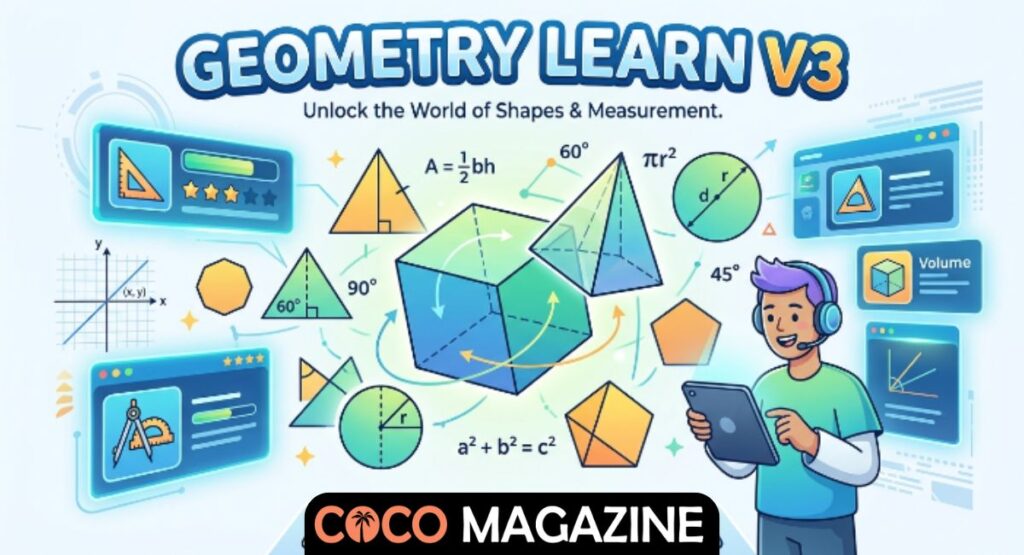
Understanding How does Geometry Learn V3 work helps explain why so many learners find it effective. The system focuses on active participation rather than passive observation. Instead of simply reading explanations, learners interact with geometric objects and receive immediate responses based on their actions.
This approach aligns closely with how the human brain learns complex information. People remember experiences more effectively than isolated facts. By creating opportunities for experimentation, the platform transforms abstract mathematics into practical exploration.
Browser-Based Accessibility and Ease of Use
One of the most attractive features of modern educational tools is convenience. As a Browser-based learning platform, Geometry Learn V3 eliminates many barriers that traditionally slow down learning. Users can often access materials directly from their web browser without installing large software packages.
This flexibility makes learning more accessible. Students can practice at school, continue at home, and revisit concepts whenever necessary. The result is a smoother and more consistent educational experience that fits naturally into daily life.
Interactive Learning Through Shapes, Angles, and Visual Models
Geometry becomes easier when learners can see concepts in action. Rather than memorizing definitions, users interact with geometric figures directly. They can explore a Point, extend a Line, examine a Ray, or understand how a Plane provides the foundation for many geometric structures.
As learners progress, they encounter increasingly complex concepts. They explore an Angle, measure Degrees, and compare an Acute angle, Right angle, Obtuse angle, and Straight angle. Visual interaction also helps students understand Complementary angles and Supplementary angles more naturally than traditional instruction often allows.
Real-Time Feedback and Adaptive Learning Features
Perhaps the most important element of modern educational technology is Real-time feedback. Instead of waiting for assignments to be graded, learners receive immediate information about their actions. This rapid response helps correct mistakes before misunderstandings become permanent.
Many systems also incorporate elements of Adaptive geometry learning. These features adjust difficulty based on learner performance. Students who progress quickly receive greater challenges, while those who need additional support can spend more time mastering foundational skills. This personalized approach contributes to stronger understanding and a more effective learning journey.
Core Geometry Concepts Covered in Geometry Learn V3
Geometry becomes much easier when learners understand the building blocks first. One of the biggest strengths of Geometry Learn V3 is that it introduces concepts in a logical order. Instead of overwhelming users with advanced formulas, it starts with the basics and gradually moves toward more complex topics. This structure makes it an effective Geometry learning platform for beginners and supports long-term understanding.
Many students search for How to understand geometry easily because traditional methods often jump too quickly into calculations. Modern systems focus on visual exploration before formal problem-solving. As a result, learners build confidence while developing a deeper understanding of important Geometry concepts that appear throughout mathematics and real life.
Points, Lines, Rays, and Planes
Every geometry lesson begins with the most fundamental elements. A Point represents an exact location without size. A Line extends endlessly in two directions, while a Ray starts at one location and continues forever in a single direction. A Line segment differs because it has two clear endpoints and a fixed length. These simple ideas create the foundation for almost every geometric structure.
A Plane provides a flat surface where many geometric figures exist. Understanding how these elements connect helps learners develop stronger spatial awareness. Rather than treating definitions as isolated facts, Geometry Learn V3 encourages users to explore how each concept interacts with others through Visual learning and active participation.
Understanding Angles and Angle Relationships
Angles appear everywhere in geometry and daily life. When two lines meet at a Vertex, they create an Angle measured in Degrees. Geometry learners encounter different types of angles, including an Acute angle, Right angle, Obtuse angle, and Straight angle. Each serves a unique purpose in mathematical reasoning and practical applications.
Relationships between angles are equally important. Complementary angles combine to form 90 degrees, while Supplementary angles add up to 180 degrees. Interactive visual models help learners see these relationships instantly. This approach improves Geometry problem solving because students understand why angle rules work rather than simply memorizing them.
Triangles, Quadrilaterals, and Polygons
Shapes form the heart of geometry. Students begin with the Triangle, one of the strongest and most important geometric figures. Different triangle types include the Equilateral triangle, Isosceles triangle, Scalene triangle, and Right triangle. Each follows specific rules that help learners understand measurements, proportions, and relationships.
As learners progress, they explore larger shape families. The Quadrilateral category includes familiar figures such as the Square, Rectangle, Rhombus, Parallelogram, and Trapezoid. These figures belong to the broader group known as a Polygon. Understanding these shapes helps answer common questions such as How to learn triangles and quadrilaterals easily, which remains one of the most searched geometry topics online.
Circles, Radius, Diameter, and Circumference
Circular shapes introduce a different type of geometric thinking. A Circle contains all points that remain the same distance from its center. That distance is called the Radius. The Diameter stretches across the circle through the center and measures twice the radius.
Students also learn about the Circumference, which represents the distance around a circle. Additional concepts such as the Arc and Sector help explain portions of circular figures. Visual demonstrations make these ideas easier to grasp because learners can see measurements change dynamically rather than relying solely on static diagrams.
Coordinate Geometry and Graph-Based Learning
Many modern careers rely on Coordinate geometry, making it one of the most practical areas of study. Learners work with the X-axis and Y-axis to locate positions and understand movement across a coordinate plane. This topic connects geometry with algebra and prepares students for more advanced mathematical concepts.
Interactive lessons often include Graph-based learning, allowing students to Plot points, measure Slope, calculate the Distance formula, and explore Geometric transformations. These activities help answer common searches such as Coordinate geometry explained with visuals, which continues to attract learners looking for easier ways to understand graphing concepts.
3D Shapes, Volume, Surface Area, and Spatial Reasoning
While two-dimensional figures appear on paper, real life exists in three dimensions. This is where Three-dimensional geometry becomes important. Students learn about shapes such as a Cube, Cone, and Sphere, along with measurements involving Volume and Surface area.
Visual interaction dramatically improves understanding of three-dimensional structures. Rotating objects on screen strengthens Spatial visualization, develops Spatial memory, and enhances overall Spatial reasoning skills. These abilities extend far beyond mathematics and play important roles in design, engineering, and technology careers.
Key Features of Geometry Learn V3
Technology continues to transform education, and Geometry Learn V3 reflects many of the innovations driving that change. Rather than acting as a simple digital textbook, it provides a dynamic learning environment designed to support engagement, understanding, and exploration. These features help explain why many learners consider it among the Best geometry learning methods in 2026.
Modern educational tools succeed when they reduce complexity while increasing understanding. Instead of presenting geometry as a collection of rules, this system focuses on interaction. Students see concepts develop in real time, making difficult topics easier to understand and remember.
Interactive Geometry Visualization Tools
One of the strongest features involves advanced Geometry visualization tools. Geometry is naturally visual, yet traditional classrooms often rely heavily on static images. Interactive systems solve this problem by allowing learners to manipulate figures and observe changes immediately.
This approach supports stronger conceptual understanding because students actively participate in the learning process. Rather than imagining how shapes behave, they see transformations happen directly. Such experiences create deeper connections and improve Learning retention.
Dynamic Shape Manipulation and Real-Time Changes
Many educational systems still depend on passive instruction. By contrast, Geometry Learn V3 encourages experimentation. Learners can resize shapes, rotate figures, and examine geometric relationships from multiple perspectives.
These activities demonstrate the value of Learning by doing. As users manipulate objects, they receive Real-time feedback that helps reinforce correct understanding. Immediate responses reduce confusion and accelerate learning progress.
User-Friendly Interface and Navigation
Complicated software often discourages learners before they even begin. A major advantage of Geometry Learn V3 is its focus on simplicity. The interface prioritizes clarity, making it easier for students to focus on mathematics rather than technology.
This accessibility benefits a wide range of users. Whether someone is a beginner or an experienced learner, straightforward navigation creates a smoother educational journey. A positive user experience often leads to stronger Student engagement and greater motivation.
Multi-Device Compatibility
Modern education happens everywhere. Students switch between school computers, home laptops, tablets, and mobile devices throughout the day. Educational tools must adapt to these changing environments.
As a flexible Browser-based learning platform, Geometry Learn V3 supports learning across multiple devices. This accessibility allows users to continue studying whenever opportunities arise. Consistent access encourages practice and helps maintain learning momentum.
Self-Paced Learning Environment
Not every learner progresses at the same speed. Traditional classrooms often struggle to accommodate individual differences. Some students need additional time, while others prefer faster progression.
The platform supports Self-paced learning, giving users greater control over their educational experience. This flexibility reduces pressure and allows learners to focus on understanding rather than rushing through material. As a result, many students develop stronger confidence and improved academic performance.
Benefits of Using Geometry Learn V3 for Students and Educators
The growing popularity of Geometry Learn V3 stems largely from its practical advantages. Students, teachers, and independent learners all benefit from its visual approach and flexible design. Unlike traditional methods that emphasize memorization, this system encourages exploration, understanding, and engagement.
The educational value extends beyond geometry itself. Learners develop broader academic skills that support success in science, technology, engineering, and mathematics. These benefits help explain why many educators continue exploring new Modern geometry education tools for classroom use.
Benefits for Students
For students, understanding geometry often feels like solving a puzzle. Traditional lessons sometimes focus heavily on formulas without explaining underlying concepts. Interactive systems bridge that gap by showing how geometric relationships actually work.
This approach supports stronger Critical thinking, enhances Problem-solving skills, and reduces Math anxiety. When learners understand concepts visually, they often feel more confident tackling difficult challenges and applying knowledge in new situations.
Improved Concept Understanding
Many learners struggle because geometry feels abstract. Visual interaction transforms abstract ideas into experiences that students can observe and explore. Concepts become easier to understand when learners see them in action.
This method supports Concept-based learning and encourages deeper comprehension. Instead of memorizing procedures, students learn why mathematical relationships exist. That understanding remains valuable long after individual lessons end.
Reduced Math Anxiety
Mathematics can feel intimidating, especially when students fear making mistakes. Interactive learning environments create a lower-pressure experience where experimentation becomes part of the learning process.
As confidence grows, anxiety often decreases. Students become more willing to explore challenging concepts and develop a healthier relationship with mathematics overall.
Better Learning Retention
Educational research consistently shows that active participation improves memory. Learners retain information more effectively when they engage directly with concepts rather than simply reading about them.
The combination of Visual learning, experimentation, and immediate responses contributes to stronger Learning retention. Students remember experiences more easily than isolated facts.
Benefits for Teachers
Teachers face constant pressure to keep students engaged while covering required material. Modern educational tools can support these goals by providing additional ways to present difficult concepts.
Many educators use visual systems as supplementary resources within broader instruction. This flexibility allows teachers to address different learning styles while maintaining curriculum objectives.
Enhanced Classroom Engagement
Student attention remains one of the biggest challenges in education. Interactive activities often generate more interest than traditional lectures because learners participate actively rather than passively observing.
Higher engagement frequently leads to improved outcomes. When students become curious about concepts, they invest more effort into understanding them.
Supplemental Learning Support
Teachers often work with classrooms containing students at different skill levels. Interactive systems provide opportunities for additional practice without requiring constant direct supervision.
This support allows educators to spend more time helping learners who need extra assistance while other students continue progressing independently.
Easy Integration Into Lessons
Modern educational tools work best when they complement existing teaching methods. Many geometry platforms fit naturally into classroom instruction because they reinforce concepts already covered in lessons.
As a result, educators can enhance learning experiences without completely redesigning their teaching approach.
Benefits for Independent Learners
Not all learning happens in school. Adults often revisit mathematics for career development, personal growth, or academic preparation. Flexible educational systems support these goals by providing convenient access to learning resources.
This accessibility makes Geometry Learn V3 for self learners particularly appealing. Users can study at their own pace and focus on areas where they need the most improvement.
Flexible Learning Schedule
Independent learners frequently balance education with work, family, and other responsibilities. Flexible scheduling allows them to study when time becomes available rather than following a fixed timetable.
This freedom makes learning more practical and sustainable over the long term.
Convenient Skill Refreshers
Many adults have not studied geometry in years. Interactive tools provide an efficient way to review important concepts without committing to a full academic course.
Whether someone needs geometry for work or personal interest, targeted practice helps rebuild confidence quickly.
Practical Geometry Practice
Regular practice remains essential for mastering mathematics. Interactive systems provide opportunities to apply knowledge immediately rather than simply reading explanations.
This hands-on approach strengthens understanding and helps learners transfer concepts to real-world situations more effectively.
Real-World Applications of Geometry Learn V3
One reason geometry remains important in 2026 is that it appears almost everywhere. Students often ask why they need to learn shapes, measurements, and angles. The answer is simple. Geometry helps people understand the physical world and solve practical problems. Through Geometry Learn V3, learners can connect classroom concepts to everyday situations more easily than ever before. This makes the study process more meaningful and improves long-term motivation.
Modern careers increasingly depend on geometry-based skills. From designing buildings to creating virtual worlds, professionals use geometric thinking every day. The platform helps learners see these connections through Interactive geometry learning, making abstract ideas feel useful and relevant. This practical focus supports stronger understanding and helps answer one of the most common questions learners ask: Real life applications of geometry.
Geometry in Architecture and Construction
Buildings do not stand by accident. Architects and builders rely heavily on geometry to create safe and attractive structures. Every wall, roof, window, and foundation depends on measurements and angles working together correctly. Understanding Architecture, Construction, and Building structures requires a strong grasp of geometric principles.
Geometry also plays a major role in Bridge design. Engineers use triangles and other shapes because they provide stability and strength. Through visual demonstrations, learners can explore why certain structures support weight more effectively than others. This practical application helps students appreciate the value of geometry beyond the classroom.
Engineering and Technology Applications
Modern technology depends heavily on geometric thinking. Engineers use geometry when designing machines, vehicles, and electronic devices. Precise measurements ensure that parts fit together correctly and function safely. These applications highlight the importance of Engineering and mathematical accuracy.
Geometry also supports innovations in software and digital design. Many modern tools rely on Spatial thinking and geometric relationships to create accurate models and simulations. Understanding these concepts can open doors to careers in technology and engineering.
Computer Graphics, Gaming, and Virtual Reality
Many students feel surprised when they discover how much geometry exists inside video games. Every character, environment, and animation depends on geometric calculations. Developers use shapes, coordinates, and transformations to create realistic digital worlds.
Fields such as Computer graphics, Video game design, and Virtual reality rely heavily on geometry. Interactive systems help learners understand how geometric principles influence movement, perspective, and visual effects. These connections make geometry more exciting for students interested in technology careers.
Navigation, Mapping, and Everyday Life
Geometry helps people move through the world efficiently. Modern GPS systems use geometric calculations to determine locations and provide directions. Professionals working in Navigation and Mapping depend on coordinate systems and distance calculations every day.
Even simple activities involve geometry. Arranging furniture, planning a room layout, or estimating distances all require geometric reasoning. Learners who develop strong geometric understanding often become better problem-solvers in daily life.
Sports and Interior Design
Sports involve far more mathematics than many people realize. Players constantly evaluate Sports angles when passing, shooting, or aiming. Understanding geometric relationships can improve decision-making and performance in many athletic activities.
Geometry also influences Interior design. Designers use proportions, symmetry, and spatial planning to create attractive living and working spaces. These practical examples demonstrate how geometry shapes both function and aesthetics in everyday environments.
Common Challenges Learners Face and How to Overcome Them
Although geometry offers many benefits, learners often encounter obstacles along the way. Some struggle with visualization, while others become overwhelmed by formulas and definitions. Understanding these challenges helps students develop better strategies for success.
Fortunately, modern educational tools address many traditional learning difficulties. By combining visual exploration with active participation, learners can overcome common barriers more effectively than with textbook-only instruction.
Why Students Struggle With Geometry
One major reason behind Why students struggle with geometry is the abstract nature of many concepts. Learners often see diagrams on paper but find it difficult to imagine how shapes behave in real space. Without visualization, geometry can feel disconnected from reality.
Another challenge involves memorization. Students sometimes focus on remembering formulas without understanding their meaning. This approach may work temporarily but often creates confusion when problems become more complex. Visual learning environments help bridge this gap by emphasizing understanding first.
Difficulty Visualizing Shapes and Relationships
Many geometry topics require strong visual thinking. Students must imagine rotations, transformations, and three-dimensional structures. This can be difficult when instruction relies only on static diagrams.
Interactive models improve understanding by allowing learners to manipulate figures directly. Observing changes in real time strengthens Spatial visualization and makes complex relationships easier to understand.
Fear of Making Mistakes
Many learners hesitate to experiment because they worry about getting answers wrong. This fear often contributes to Math anxiety and reduces confidence. Traditional classrooms sometimes reinforce this problem when mistakes receive immediate criticism.
Interactive systems create safer learning environments. Learners can test ideas, make corrections, and explore concepts without embarrassment. This freedom encourages curiosity and supports deeper understanding.
Strategies for Success
Success in geometry depends on consistent practice and active engagement. Learners who interact with concepts regularly develop stronger intuition and greater confidence. Visual exploration often proves more effective than memorization alone.
The following table highlights common challenges and practical solutions:
| Challenge | Solution |
| Difficulty visualizing shapes | Use Geometry visualization tools |
| Confusion about formulas | Focus on Concept-based learning |
| Fear of mistakes | Practice with Real-time feedback |
| Weak spatial skills | Use interactive 3D models regularly |
| Low engagement | Explore Interactive mathematics activities |
| Slow progress | Follow Self-paced learning methods |
Geometry Learn V3 vs Traditional Geometry Learning Methods
Educational technology continues to transform how people learn mathematics. Comparing modern tools with traditional approaches helps learners understand which methods best fit their needs. Both approaches offer advantages, but they differ significantly in how they deliver information.
Many discussions about the Difference between traditional and digital geometry learning focus on engagement, accessibility, and understanding. Modern systems prioritize interaction, while traditional methods often emphasize direct instruction and repetition.
Traditional Learning Approach
Traditional geometry education usually relies on textbooks, lectures, worksheets, and classroom discussions. These methods provide structure and consistency. Many students still benefit from direct instruction and teacher guidance.
However, traditional methods sometimes make visualization difficult. Learners must often imagine movement and transformations based solely on static images. This can create challenges for visual learners who need more interactive experiences.
Digital Geometry Learning Approach
Modern educational systems embrace technology to enhance understanding. Digital geometry learning focuses on participation, exploration, and immediate feedback. Students interact directly with geometric figures and observe results in real time.
This approach supports stronger engagement and often improves retention. Learners gain opportunities to explore concepts independently while receiving guidance through visual demonstrations and adaptive learning experiences.
Comparison Table
| Feature | Traditional Learning | Geometry Learn V3 |
| Learning Style | Lecture-based | Interactive exploration |
| Feedback Speed | Delayed | Real-time feedback |
| Visualization | Static diagrams | Dynamic visual models |
| Accessibility | Classroom dependent | Online access |
| Engagement | Moderate | High |
| Flexibility | Fixed schedule | Self-paced learning |
| Student Participation | Limited | Active |
| Technology Use | Minimal | Advanced |
Which Method Works Better?
The best results often come from combining both approaches. Traditional instruction provides structure and expert guidance. Interactive tools provide exploration, experimentation, and visual understanding.
Rather than replacing teachers, modern systems enhance learning experiences. This balance allows students to benefit from both expert instruction and independent discovery.
Is Geometry Learn V3 Worth Using in 2026?
The question Is Geometry Learn V3 worth it continues to appear across educational discussions. Based on current trends, the answer depends largely on learner goals and expectations. Students seeking a more engaging way to study geometry often find significant value in interactive learning environments.
The platform’s greatest strength lies in making difficult concepts easier to understand. Through Visual geometry learning, learners can see relationships rather than simply read about them. This supports stronger comprehension and helps reduce frustration.
Advantages Worth Considering
One major advantage involves accessibility. As a Geometry learning software for students, the platform provides opportunities to learn anytime and from almost anywhere. This flexibility supports consistent practice and encourages independent learning.
Another benefit is engagement. Interactive experiences help maintain attention and improve understanding. Many learners who struggle with traditional instruction discover that visual exploration makes geometry far more approachable.
Potential Limitations
No educational tool solves every problem. Learners still need discipline, practice, and persistence. Technology can support learning, but it cannot replace effort entirely.
Some users may also prefer structured classroom environments. While interactive systems offer flexibility, certain learners benefit from direct guidance and formal instruction. Understanding personal learning preferences remains important when choosing educational resources.
Final Verdict
For learners seeking a modern, engaging, and flexible approach to geometry, Geometry Learn V3 review 2026 discussions generally highlight positive experiences. The platform supports understanding, encourages exploration, and helps learners develop stronger mathematical confidence.
When combined with consistent study habits, it can become a valuable supplement to traditional learning methods.
Final Thoughts
Geometry Learn V3 represents a growing shift toward modern educational experiences. Instead of relying entirely on memorization, it encourages learners to explore, interact, and understand. This focus on participation aligns closely with current trends in Modern geometry learning and educational technology.
Whether you are looking to Learn geometry online, improve classroom performance, or refresh forgotten skills, interactive learning environments can make the process more engaging. The combination of visualization, exploration, and immediate feedback helps transform geometry from a difficult subject into an understandable and practical skill.
The future of mathematics education continues to evolve. As technology advances, tools like Geometry Learn V3 will likely play an increasingly important role in helping learners develop confidence, understanding, and success in geometry.
FAQ’s About Geometry Learn V3
What is Geometry Learn V3?
Geometry Learn V3 is a modern geometry learning platform that helps users understand shapes, angles, and spatial concepts through interactive and visual learning methods.
What is the app that teaches geometry online?
Several apps teach geometry online, but Geometry Learn V3 is known for its interactive approach, visual tools, and easy-to-use browser-based learning experience.
Where can I play Geometry for free?
You can find free geometry learning tools and browser-based geometry platforms online. Availability depends on the specific website or educational platform offering free access.
Can you learn geometry online?
Yes, you can learn geometry online through interactive lessons, videos, practice exercises, and visual learning platforms that make complex concepts easier to understand.
Are geometry games good for kids?
Yes, geometry games can help kids improve problem-solving, spatial reasoning, and critical thinking skills while making math more engaging and enjoyable.
People Read Also: Jessie Murph Age in 2026: Biography, Net Worth, Height, Family & Career

Welcome to Coco Magazine! I’m a digital marketer and content writer with over 9 years of experience, helping brands grow through strategic content and ethical outreach. Guest contributors and collaborators are always welcome here.