

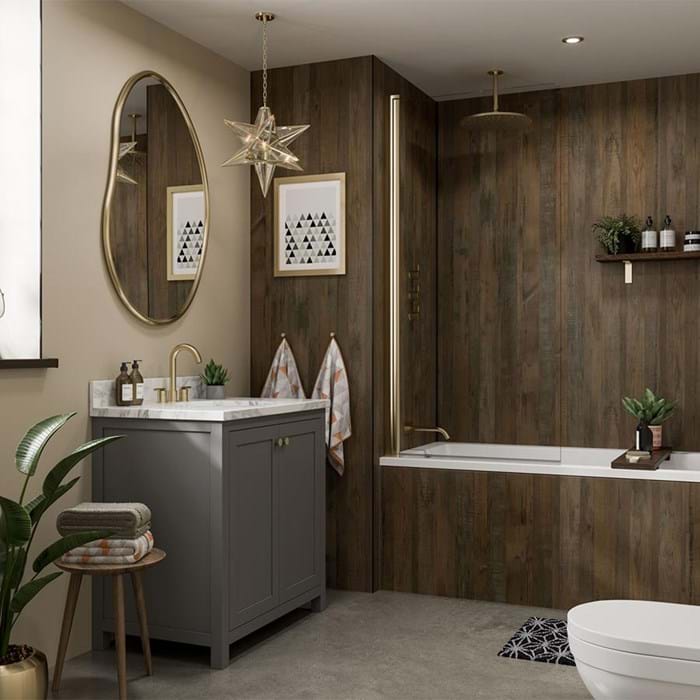
Wet rooms have moved well beyond the preserve of high-end new builds. Over the last decade, they’ve become a practical choice for homeowners across the UK who want a cleaner, more open bathroom without the long-term maintenance headaches that come with traditional tiling.
This shift is partly about aesthetics and partly about practicality, and here’s where it gets interesting: the wall finishes people choose are changing just as dramatically as the layouts themselves.
The moss wall art finishes people choose are changing just as dramatically as the layouts themselves.
What Makes a Wet Room Different to a Standard Bathroom
A wet room is, at its core, a fully tanked space. The floor and walls are waterproofed before any finish is applied, which means there’s no separate shower enclosure or tray. Water drains away directly from the floor, typically through a linear or point drain set flush with the tiles or boards.
This creates a more open, uncluttered look, but it also puts greater demands on the materials used. Every surface needs to handle constant moisture exposure without warping, staining, or providing a foothold for mould. That’s where wall finish selection becomes more than an aesthetic decision.
Why Tiles Are Losing Ground in Wet Room Installations
Tiles have been the default wall finish for wet rooms and bathrooms for generations, but they bring a significant weak point: grout. In a fully wet environment, grout lines absorb moisture over time, discolour, and become a breeding ground for mould and mildew. Keeping them clean requires regular scrubbing, and re-grouting is an inevitable expense down the line.
Large-format tiles reduce the number of grout lines, but they’re heavy, expensive to install, and unforgiving if the substrate isn’t perfectly flat. For many homeowners, the cost and complexity simply don’t add up for a bathroom renovation.
PVC Wall Panels as the Practical Alternative
PVC cladding panels have gained real traction in residential wet rooms because they solve the grout problem entirely. A large sheet covers a wide area with no joints in the middle of the wall, which means no grout lines, no places for moisture to penetrate, and no mould to scrub out six months after installation.
Opting for white wall cladding in a satin finish is a popular choice for wet rooms because the surface reflects light without the harsh glare of a full gloss panel. It also shows up dirt and water marks clearly, which sounds like a negative but is actually useful in a hygiene-sensitive environment. A quick wipe is all that’s needed to restore the finish.
Waterproofing and Substrate Prep Still Matter
One misconception is that switching to PVC panels removes the need for careful waterproofing underneath. It doesn’t. The panels themselves are fully waterproof, but the wall behind them still needs to be properly sealed, especially around penetrations like pipework and shower fixtures.
The most common approach is to apply a tanking membrane to the walls before fitting the panels. This gives you a belt-and-braces system: the substrate is protected even if moisture ever finds its way behind a panel at an edge or seal point.
Fitting and Sealing PVC Panels in a Wet Room
PVC panels can be fixed directly to a clean, dry wall using a suitable adhesive, or mechanically fixed with screws where the substrate allows. For wet rooms, adhesive bonding is more common because it avoids drilling through the panel face.
Edges and internal corners need to be finished with matching trim profiles, and all joints should be sealed with a sanitary-grade silicone. Getting the silicone bead right is worth taking time over. A poorly finished joint is the most likely point for moisture ingress in any cladded wet room.
What It All Comes Down to
Wet room design has shifted significantly in UK homes, and the materials being used on the walls reflect that change. Tiles remain a valid option, but PVC cladding panels offer a practical, lower-maintenance finish that suits the demands of a fully wet environment.
The absence of grout, the ease of cleaning, and the straightforward installation make them a sensible choice for both new-build wet rooms and bathroom conversions. Get the substrate prep and sealing right, and the finish will hold up well for years.
